
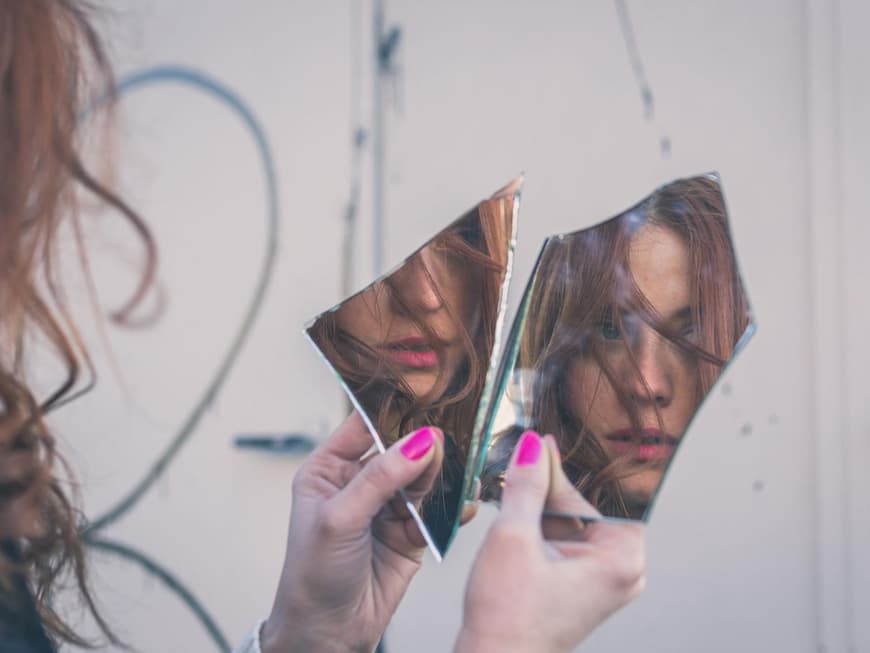
Sandra grew up in a small town in Bavaria. There is always something going on at home, thanks to her three siblings. Sandra is the runt of the litter and is often not taken seriously by the rest of the family. "I was always the sensitive one and somehow never good enough. My three brothers were better at everything than me. At least that's how my parents always portrayed me," Sandra explains today. When she put on a bit of weight in puberty, she was subjected to ridicule from her whole family. They teased her, calling her just Pummel-Sanni. "That really hurt me. I wasn't particularly self-confident anyway, but during this phase I was also losing what little self-esteem I had," admits Sandra. And then one day, the young girl believes her family.
Sandra needs over two hours in the bathroom in the morning
But that's not all: Sandra begins to downright hate herself. She finds everything about herself repulsive, downright disgusting. "It started with the weight. But pretty soon I realized that my face was abnormally ugly. I just thought: no wonder no one in my family likes me. With this face." Sandra starts to apply make-up. But it didn't stop at a little blusher and mascara, like girls her age. "When I was 16, I wore four to five layers of make-up. I didn't dare go out without it. No matter which mirror I looked in, I saw this ugly grimace. My friends were completely shocked and kept asking me why I was suddenly wearing so much make-up. I was so ashamed of my appearance and was sure that they thought the same about me. But I never spoke to anyone," she says.
It takes Sandra over two hours every morning to get ready. She tapes her ears to her head because she thinks they are sticking out. For fear that someone might laugh at her "ugly tangled hair", which in reality has a beautiful natural wave, she hides her hair under a hat every day. Even at the height of summer. "Everything revolved around my appearance. And I always related everything to myself. If someone laughed in the school playground, I thought: they're laughing at me. I could no longer think normally and was very lucky to pass my A-levels."
She hardly has any friends left
The quiet hope that things might change now is quickly dampened. Even during her training as an office administrator, everything revolved around her imaginary ugliness. Sandra hardly has any friends at this point. "At some point, most of them were too annoyed by my constant questions about my appearance. They thought I was conceited and arrogant." Nobody realized that the opposite was true and that she urgently needed help. And Sandra withdraws more and more. After vocational school, she goes straight home and isolates herself.
The severe panic about her appearance is now compounded by a severe depressive phase. She hardly dares to go out on the street. She keeps getting into trouble at school because she is late. Because she stands in front of the mirror for hours again, looking at herself from all sides and trying to cover up or conceal every little supposed flaw.
"I slowly realized that I was suffering from something that was defining my life."
Only Miriam, Sandra's best friend from childhood, is always there to support the then 23-year-old, even during these times. She is also the one who eventually discovers the disease KDS through internet research - and gets Sandra an appointment with a specialist. He confirmed the suspicion. At last! The condition has a name. "I underwent psychotherapy and had to take medication. Then I slowly realized: I was suffering from something that was affecting my whole life."
Sandra learns with her psychotherapist how to break the patterns of behavior she has learned. It is a long road and there are repeated setbacks. Her fears are too deep-seated. But slowly she makes progress - towards a life without constraints.
Body dysmorphic disorder: tips and information
We all have a day when we don't like the way we look. But those affected by this disorder downright hate themselves. What exactly is behind this particular disorder?
What are the symptoms of body dysmorphic disorder?
This mental illness is still little researched and little known. Those affected often have strong feelings of shame and anxiety about their appearance. Their thoughts constantly revolve around their own appearance. Compulsions are often added to this. For example, constantly examining themselves in the mirror - or completely avoiding looking at themselves. One in five people undergo cosmetic surgery without their symptoms improving. These are just some of the possible symptoms of this disease.
Who is affected and how many sufferers are there?
Studies have found that around two percent of people suffer from KDS. In 80 percent of cases, the disease breaks out during puberty. According to US studies, 61 percent are unemployed and 70 percent are single. Another 70 percent are suicidal and 20 percent actually try to kill themselves.
What triggers this mental illness?
A combination of genes and risk factors is said to trigger the outbreak. These include bullying and abuse in childhood, as well as excessive attention to outward appearances in the family.
Help is available here
The Institute of Psychology at the University of Münster has had its own KDS outpatient clinic since 2014. www.uni-muenster.de/KDSAmbulanz/
The Technical University of Braunschweig has a special outpatient clinic for body dysmorphic disorder. Informative website: www.tu-braunschweig.de
The only clinic in Germany specializing in BDD to date is the Schön-Klinik in Bad Bramstedt near Hamburg. www.schoen-kliniken.de